
06 Kernel 与 Triton
06 Kernel 与 Triton
Section titled “06 Kernel 与 Triton”GPU 细节
Section titled “GPU 细节”回顾上一章, GPU 内部有 Thread, Thread Block, Warps 几个概念。
Block 是一组 Thread,可能包含多个 Warps。在同一个周期内,Warps 必须在同一个 SM 上执行同一组命令,一个 SM 也可以同时面向多个 Warps,并且通过调度器执行切换。
Bank Conflict
Section titled “Bank Conflict”每个 SM 会被分成若干个 bank(例如 32 个 bank,每个 bank 有 4 字节),在同一个时钟周期内一个 bank 只能被一个 thread 访问,也就是说多个 thread 想访问同一个地址必须串行访问。
体现在实际计算中,例如一个矩阵多个 thread 都想访问第一行,则只能进行串行排队等待。
同样地,由于物理 SM 数量的限制,即使可以创建很多个 thread block,但是一个 wave 只能运行 SM 数量的 thread。
Benchmark & Profile
Section titled “Benchmark & Profile”在修改或者写 kernel 之前应该要做好 Benchmark 来首先判断好代码本身的运行情况。
在正式开始测试前应当做好 warm up 确保代码已经完成编译。
测试 GPU 时间可以使用 torch.cuda.Event() 来标记开始和结束的时间,另外注意使用 torch.cuda.synchronize() 等待 GPU 的同步,这是因为 GPU 是异步执行的。
Profiling 的作用是分析不同代码运行所花费的时间。
对同一个 GeLU 的实现中,普通的自行实现需要调用多个 Kernel,会涉及到多个 HBM 的读写,官方实现(内置 Kernel)以及 torch compile 的实现(Triton Kernel)都快得多,因为只需要一次 HBM 的读写。
Triton Kernel
Section titled “Triton Kernel”在使用 CUDA 编程时,是逐个线程进行编程的,可以同时编程一个 Grid 的 Thread Block 做元素级别的操作,非常接近于硬件底层。Triton 是由 OpenAI 开发的一种类似于新的规范,在 Triton 中思考的是 Block 级别的操作。
GeLU 运算
Section titled “GeLU 运算”以一个 GeLU 为例,以下是一个简单的 triton block 初始化
def triton_gelu(x: torch.Tensor):    # Check input    assert x.is_cuda    assert x.is_contiguous()
    # Allocate output tensor    y = torch.empty_like(x)
    # Determine grid (elements divided into blocks)    # | T T T T T T T T | T T T T T T T T | T T T T T T T T | T T T T T T T T |    # |    Block 0      |    Block 1      |     Block 2      |    Block 3     |    num_elements = x.numel()  # @inspect num_elements    BLOCK_SIZE = 1024  # Number of threads    num_blocks = triton.cdiv(num_elements, BLOCK_SIZE)  # @inspect num_blocks
    # Launch the kernel    kernel = triton_gelu_kernel[(num_blocks,)](x, y, num_elements, BLOCK_SIZE=BLOCK_SIZE)
    # Write out PTX (look at this later)    output_ptx("triton_gelu", kernel)  # @stepover
    return y
下方是 kernel 的实际实现,每一个 block 对应一个 pid,所有的 thread 执行的是同一段代码。
@triton.jitdef triton_gelu_kernel(x_ptr, y_ptr, num_elements, BLOCK_SIZE: tl.constexpr):    # Input starts at `x_ptr`    # Output starts at `y_ptr`
    # | T T T T T T T T | T T T T T T T T | T T T T T T T T | T T T T T T T T |    # |    Block 0      |    Block 1      |     Block 2      |    Block 3     |
    pid = tl.program_id(axis=0)      # Identifies the block    start = pid * BLOCK_SIZE         # Starting index of this block
    # Indices where this thread block should operate    offsets = start + tl.arange(0, BLOCK_SIZE)
    # Don't read/write past the end of the tensor    mask = offsets < num_elements
    # Read    x = tl.load(x_ptr + offsets, mask=mask)
    # Approx gelu is 0.5 * x * (1 + tanh(sqrt(2/pi) * (x + 0.044715 * x^3)))    # Compute (tl.tanh doesn't exist, use tanh(a) = (exp(2a) - 1) / (exp(2a) + 1)    a = 0.79788456 * (x + 0.044715 * x * x * x)    exp = tl.exp(2 * a)    tanh = (exp - 1) / (exp + 1)    y = 0.5 * x * (1 + tanh)
    # Store    tl.store(y_ptr + offsets, y, mask=mask)
在经过编译后生成的是 PTX 代码,再向下还有额外的细节是无法干预的。
Softmax
Section titled “Softmax”在 softmax 中会有更加复杂的运算,包括归约,取最大值等,如果用朴素的实现,需要用到非常多的 Kernel,导致很多额外的读写开销。
在 Triton 中一般把一个行(row)作为一个 block,因为 softmax 的操作只与行内元素有关。这里只展示 Kernel 部分:
@triton.jitdef triton_softmax_kernel(x_ptr, y_ptr, x_row_stride, y_row_stride, num_cols, BLOCK_SIZE: tl.constexpr):    assert num_cols <= BLOCK_SIZE
    # Process each row independently    row_idx = tl.program_id(0)    col_offsets = tl.arange(0, BLOCK_SIZE)
    # Read from global memory    x_start_ptr = x_ptr + row_idx * x_row_stride    x_ptrs = x_start_ptr + col_offsets    x_row = tl.load(x_ptrs, mask=col_offsets < num_cols, other=float("-inf"))
    # Compute    x_row = x_row - tl.max(x_row, axis=0)    numerator = tl.exp(x_row)    denominator = tl.sum(numerator, axis=0)    y_row = numerator / denominator
    # Write back to global memory    y_start_ptr = y_ptr + row_idx * y_row_stride    y_ptrs = y_start_ptr + col_offsets    tl.store(y_ptrs, y_row, mask=col_offsets < num_cols)
如果一次操作的所有的数据都可以放进一个 block,那么这个写法就类似于 pytorch 了。难点在于如果是一个非常大的矩阵,一个 block 无法完成。
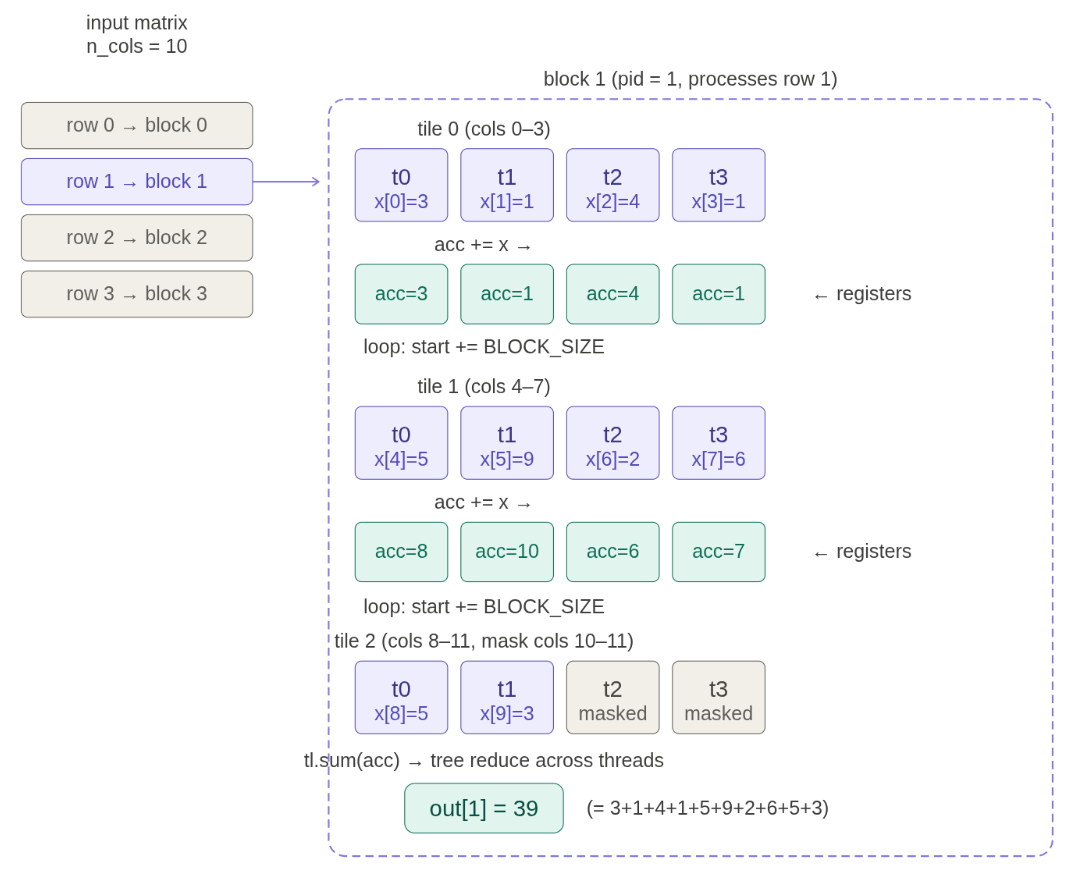
此时每一个 block 仍然是负责同一个行,每一个 thread 共同维护各自的累加器,最后再一个 loop 全部加起来,具体的代码省略。